• Twitter
  • Google+
  • Instagram
  • Pinterest
  • Tumblr
  • RSS

Dad of Divas

One Dad's Quest to Regain Control of his Kingdom

  • About
  • Dads in the Limelight
  • Contests and Giveaways
  • Fatherhood
  • Reviews
    • Book Reviews
  • College Preparation
  • Disclaimer
  • Entertainment
    • Disney
  • Podcast
  • Travel
  • Work With Me
  • Cookie Policy

Encouragement Over Praise: A Guide to Boosting Your Daughter’s Self-Esteem

April 21, 2025 by dadofdivas

https://pdcn.co/e/traffic.libsyn.com/0b32651f-5d5d-453b-be58-a4f9dac21863/Martha_Burich-FINAL.mp3

Podcast: Play in new window | Download

In today’s fast-paced world, the importance of a strong bond between fathers and daughters cannot be overstated. As highlighted in the recent episode of The Dad and Daughter Connection podcast featuring Martha Burich, nurturing these relationships is essential not only for personal development but also for fostering a sense of security and confidence in young women. Martha Burich, speaks about her book “Yes, You Can Raise Happy, Responsible Children” and shares some of the things that she has learned and shared through her writing to help all parents.

Dr. Christopher Lewis and Martha Burich delve into the complexities of father-daughter dynamics, emphasizing that fathers play a pivotal role in shaping their daughters’ perspectives on life and relationships. While mothers naturally receive recognition for their nurturing roles, Burich points out that fathers often don’t get the accolades they deserve, despite being fundamental to their daughters’ emotional and psychological development.

Martha shares her personal story, detailing the challenges and triumphs within her own father-daughter relationship. Her father, affected by his experiences as a prisoner of war, faced demons that impacted their family life. Despite these challenges, Martha highlights moments of learning and tenderness, illustrating that love and kindness can coexist with imperfections.

A significant theme of the podcast is the idea that fathers must actively engage with their daughters to help them grow into resilient and independent women. This engagement includes encouraging daughters to fail and learn, breaking the cycle of needing perfection for validation. The podcast underscores the difference between praise and encouragement – with the latter focusing on effort and growth rather than outcome, fostering a mindset of persistence.

Discipline, another critical component of parenting discussed, is portrayed not as a harsh reality but as a foundation for building respect and boundaries. Children, Martha explains, need to learn the value of ‘no’ for long-term personal and societal benefits. Fathers, therefore, should strive to create environments where discipline is balanced with love, ensuring their daughters understand and respect boundaries while feeling supported.

Moreover, the power of everyday interactions is highlighted as being instrumental in shaping a child’s emotional well-being. Fathers are encouraged to engage in meaningful dialogue with their daughters, asking about their daily highs and lows to foster deeper connections. Listening, rather than always providing solutions, is presented as a tool for building trust and understanding.

Ultimately, the podcast serves as a reminder that being a present and engaged father isn’t about perfection—it’s about authentic connection and consistent involvement. By focusing on these themes, fathers can better support their daughters in becoming confident, independent individuals prepared to face the world’s challenges.

TRANSCRIPT

Dr. Christopher Lewis [00:00:02]:
Welcome to the dad and daughter connection, the podcast for dads who want to build stronger bonds and raise confident independent daughters.

Dr. Christopher Lewis [00:00:12]:
If you’re looking to build a stronger bond with your daughter and help her grow into a confident, independent woman, you’re in the right place. I’m doctor Christopher Lewis, and the dad and daughter connection is the podcast where we dive into real stories, expert advice, and practical tips to help you navigate the incredible journey of fatherhood. In every episode, we’ll bring you conversations that inspire, challenge, and equip you to show up as the dad your daughter needs. So let’s get started. Because being a great dad isn’t just about being there, it’s about truly connecting. Welcome back to the Dad and Daughter Connection. I am so excited that you are here this week. And as always, every week, I love being able to sit down, talk to you, work with you as you are working to create that strong connection with your daughter.

Dr. Christopher Lewis [00:01:09]:
No matter where you are right now, there are always things that you can do to be able to build a stronger relationship, but also a stronger connection in general with your daughter. And that’s what this show is all about. Every week, I wanna be able to offer you opportunities to be able to learn, to grow, to be able to identify new ways that you can create those strong bonds that are going to help you and your the relationship with your daughter as you continue on together. That’s why every week I bring you different guests, different people with different experiences that can give you some perspective on this. And hopefully, at the end of every episode, you’re gonna be having some some notes that you’ve taken, some things that you’ve thought about, some maybe brain explosions that allow for you to be able to say, hey, I haven’t thought about it that way, but maybe I can think about things a little bit differently. Maybe I can do some things a little bit differently. This week, we’ve got another great guest with us. Martha Birch is with us.

Dr. Christopher Lewis [00:02:07]:
And Martha is an author, a speaker. She’s a behavioral change consultant. And she has a new book that is out called Yes, You Can Raise Happy Responsible Children. Now don’t all of us want to raise happy, responsible children? I know that I definitely want my kids to be happy and responsible and would have loved to have had this when they were very young as well. So we’re gonna be talking to her about not only her own experience as a daughter herself, but also talk about this new book with the resources that are in it that could help you with your relationship with your daughters. Martha, thanks so much for being here today.

Martha Burich [00:02:45]:
Chris, I’m absolutely thrilled to be here. Your dads are so important. And, you know, it seems to be in our society today that dads don’t get the accolades and they don’t get their due because father daughter relationships are pivotal for positive adult male female relationships.

Dr. Christopher Lewis [00:03:03]:
Definitely agree with you there. It is so important. I mean, there’s so much research that’s out there that shows that, and it is still important. I’m not negating the importance of the bond between the mother and the daughter, because that is crucial as well. But every study that I have seen out there, every study that I’ve read shows that daughters without a father that is actively engaged in their lives, it severely impacts their ability to be strong, independent individuals in society and definitely makes a difference. So, so I would love to start with delving a little bit deeper into your own relationship with your own father. And I know at the beginning we talked about the fact that your relationship was, I said, was it positive? Was it negative? Was it somewhere in between? And you said it was somewhere in between. So talk to me a little bit about that relationship.

Dr. Christopher Lewis [00:03:50]:
And you said it was in between. Talk to me about that. What made it in between for you?

Dr. Christopher Lewis [00:03:55]:
And and

Dr. Christopher Lewis [00:03:55]:
then we’ll we’ll go from there.

Martha Burich [00:03:56]:
Well, my father was a prisoner of war of the Germans in World War two before I was born for two years, and that definitely skewed him. You know, he was a very, very nice man, a kind man. He he never yelled, but he was affected and it affected him. He became a very heavy drinker, but you could never tell. He he was never drunk. I guess maybe he was always drunk. I don’t know. You can never tell.

Martha Burich [00:04:20]:
But he he pretty much gambled and drank all the money away. And, on the one hand, you can’t blame him because who when people go through experiences, we have no idea what he went through. But then on the other, you know, my mother would tell me stories of when I was very, very young and there was no food. We had no food because my dad drank and gambled at all. So he could be the kindest man in the world, but he was irresponsible in that way. So, yes, we had a bit of a rocky relationship. I I don’t know. There was never any outright animosity or anything, but, you know, my parents divorced when I was about five.

Martha Burich [00:04:51]:
So I didn’t see my dad a lot, but I did see him about once a year. And I want to tell you a story. When I was about seven, my stepmother was a very heavy drinker. She was an alcoholic and a mean drunk. And I think I was seven or eight and she got mad at me for something. I I don’t know what I did. So I went to bed and pretended to be sleeping. And my dad came home, and she just Martha this and Martha that and blah blah.

Martha Burich [00:05:13]:
Just I guess I could do no right. And my dad looked at her and he said, Kathleen, she’s eight years old. What could she possibly have done that that’s bad? But, you know, that kinda tells who my dad was. He he really was a kind human being. And I remember another time we had a dog. Oh, this really touches me. He had a dog. We didn’t have a dog at my mother’s house, but dad had a dog.

Martha Burich [00:05:36]:
And the dog threw up in the car one time, and dad was cleaning it. And I was very young, and I said, how can you do that? And he goes, when you love something, you take care of it. That just touches my heart because my dad really was a caring and loving man, but he had these demons I think that ran him a little bit and made him not as positive an influence as he could have been.

Dr. Christopher Lewis [00:05:56]:
Now, you talked about those demons and some men have those, some fathers have those in their lives and they have to deal with those or if they don’t, it’s going to impact the relationships around them. As you and your father grew in your relationship as you got older and and he got older as well, talk to me about those demons and how or if you ever had an opportunity to talk through that with your father. And if not, what do you wish you would have talked to him about?

Martha Burich [00:06:28]:
Yeah. No. We we never we never discussed it. I don’t think he ever discussed it with anyone. I think that was something that he probably took to his grave. And, you know, my brother and I were were both talking about, you know, was our dad an alcoholic? Because he would drink a fifth a day, but he would be the same person all day long. A lot of people drink and they become mean or just unpleasant and silly. But my dad was the same person all day long, so we really don’t know.

Martha Burich [00:06:53]:
We think maybe he was just a heavy drinker, but that’s a pretty heavy drinker. Let’s talk about the importance of dads. And and, you know, for for my dad or for dads, if you have a drinking problem, it’s time to get it get it solved because you’re not helping your family or your children or society in general. So it really is time to take a look at yourself. I go to the jail every Monday and the treatment center every Wednesday, and I talk to the women, addicts and alcoholics. And, you know, a lot of them have mixed relationships with their parents, with their dad, with the men in their lives. They expect I think we become confused about relationships. What’s the point of a relationship? To build a future together.

Martha Burich [00:07:29]:
Not to constantly make one another feel good, but to build a future together. Where are we going with this? How do we want our children to behave? What do we wanna have in ten years, in twenty years? How are we gonna build that? But if we’re constantly men do this and women do that, then we’re wasting our time, really, basically. You know, that’s another thing too. We’re constantly looking for highs and pleasure, immediate pleasure. Well, then we’re we’re ruining our lives that way because if people who can’t say no to themselves become people who are addicts, alcoholics, very unpleasant to be around. So we have to learn how to say no to ourselves and to our children. And I think that’s part of what’s happening in society today is children aren’t hearing no the way they need to, and then they don’t say no to themselves, and then everybody’s miserable.

Dr. Christopher Lewis [00:08:13]:
Now with that mixed relationship that you had with your dad, with the highs, the lows, and probably the in betweens as well, are there things that you wish that your dad had done differently when it came to building the relationship that you had?

Martha Burich [00:08:27]:
Yes. You know, my dad was was a hunter, and he shot deer, you know, being here in Michigan. I wish he would have taken me hunting or things that he did with my brother that he he never did with me. You know, there’s a picture of my brother when he was two standing on the bumper of a car while my dad’s fixing it. My brother’s got a little tool in his hand that he’s gonna hand to my dad. Well, I didn’t get to do that. I have a friend whose dad, she has four boys, but her dad taught her everything. She can tear down a car.

Martha Burich [00:08:55]:
She can take the engine out of it and put it back together because her dad taught her how to finish furniture, how to do all that cool stuff, the kind of stuff that makes you feel competent and and useful. So that, I wish that he would have showed me how to do a lot more things than he did. I have another story. Let me tell you a story, Chris. I have a friend. He’s got grandchildren, and this is about his grandson. Anyway, the grandson was about four, and he had one of those little, gas powered motorcycles. This is a real one.

Martha Burich [00:09:22]:
And the kid’s four, and I think it it went fast. Anyway, so he’s toodling around, and dad and and, grandpa are watching the child out in the field with his little motorcycle. And he comes around, and he comes up to grandpa. And grandpa goes, you know, I don’t think you’re going fast enough. Would you like to go fast enough? Said no mother ever said no. And, you know, that’s another reason why dads are so important because dads take you fishing. You see grandpa and the daughter with the you’re fishing. Dads do all that kind of cool stuff, teach you how to fix things and do things.

Martha Burich [00:09:52]:
And, you know, so it’s really, really an important relationship. And another thing that, I wanted to you probably already know this. College, when parents take their children to colleges to look at them, it’s usually dads and daughters, moms and sons. I heard this from a person who worked at a college who did the college days.

Dr. Christopher Lewis [00:10:10]:
I have seen that, and that is an interesting dynamic that you don’t always think about, but it is true. So, as you think back to the relationship that you had with your father throughout your life, how has that relationship that you had with your father influenced the way you navigate life, relationships, or challenges today?

Martha Burich [00:10:30]:
Well, that’s such an interesting question. My husband was a very nice man. He died in 02/2008, and, we were married twenty five years, and he was a gentle soul like my dad. I remember one time, his name was Tony. Tony and I were looking at our son, Anthony, when he was a baby. We used to have date night, I think, on Friday or Saturday night. We came home, and then we would watch look at Anthony in his room, in his little crib sleeping. And I remember one time, my husband looked at me and he said, I don’t know what I would ever do if anything happened to this baby.

Martha Burich [00:10:57]:
You know? And I just I just remember thinking what a tender heart he has.

Dr. Christopher Lewis [00:11:01]:
Now if I know your your father has passed, and I guess if you look back now or if you could spend one more day with your dad and do anything, what would it look like?

Martha Burich [00:11:12]:
That’s really interesting. What would it look like? I guess I would just sit with him, ask him about his life. My brother and I are both confused because we believe our dad was adopted. There’s there are no records, and I was looking back through genealogy. And we think he was adopted by his stepdad. But, see, we just had no relationship with his side of the family at all. So there are so many questions when it comes to our dad.

Dr. Christopher Lewis [00:11:37]:
Now I mentioned at the beginning that you had, that you’ve put out a new book called Yes, You Can Raise Happy, Responsible Children. As an author myself, I know how much time and effort goes into the, and some blood, sweat, and tears go into the writing of these books to get great content out in front of the world. But, I guess, talk to me about the impetus and what made you decide that this book needed to be written and that you wanted to put it out into the world.

Martha Burich [00:12:09]:
Well, that’s a really great question. You know, my son’s grown now, and he’s successful. He has his own business. When he was four, he was just spoiled rotten. His dad and I, we thought the way that you raise a happy child is you always say yes. No. That didn’t work too well. And I remember one day carrying him outside of a store because I finally learned to say no, and I meant it.

Martha Burich [00:12:28]:
This time, I really meant it. And he was in shock. He was in shock. I had to carry him out of the store screaming and kicking and everything else because I had finally learned to say no and put my foot down and then took parenting classes. And in six weeks, we turned him around from being so spoiled that we really didn’t like him very much. He was very unpleasant to a very cooperative, pleasant young man. As I said, he’s he’s successful now and he’s grown. And everything that I learned there, I put in the book because and it’s also the information that I used.

Martha Burich [00:12:57]:
I was ten years as a child psychology professor and sixteen years as a high school special education teacher. And all the information that I put in the book are the same things that I used to communicate with my parents, with my students, and also with the ladies and the the people at the jail and the treatment centers. So, yes, it’s only 60 pages and pretty much just tells you, here’s what you do at the grocery store if the child won’t behave. Here’s what you do if they won’t put their seat belt on. It’s just boom, boom, boom. A quick read to help here’s what you do to improve their, self esteem, to help to get you to the place where your children are cooperative and you’re working together. Because so often as parents, our children don’t realize that we’re a unit. We’re a family unit.

Martha Burich [00:13:36]:
Family is the basis of society, and a happy family helps create a happy society. So our families, just like our partnerships, need to be what’s our goal? Our goal is to build our family to be happy and healthy and to work together to help each other.

Dr. Christopher Lewis [00:13:51]:
And I love books that are practical and be able and allow you to be able to take something right out of it and put it into into action right away. Now I know that in reading through your book, your book really emphasizes the importance of building self esteem in children. How can fathers specifically help their daughters develop confidence and resilience, especially in a world that often challenges their sense of worth?

Martha Burich [00:14:17]:
Let them fail. Just you’ve got to encourage them to try everything and fail. Go after if you wanna if the daughter comes on here let me tell you this story. This is a typical one too. The child come home from school and go, they’re having a play at school. They’re having a play at school. I’m so excited. I’m gonna try out for the lead.

Martha Burich [00:14:34]:
Oh, honey. Oh, I’m so glad they’re having a play, but the lead, you might not get it. Why don’t you try to be one of the frogs? You’ll get that part. I bet you’ll get that part. Already, we’re teaching our children to not go after what they really want, to go after what they think they can get. This is how you get adults who go, you know, I I I probably won’t get that job. I won’t even try for it. I probably won’t be able to, you know, that person would never date me.

Martha Burich [00:14:58]:
I’m not even gonna try. So we have to teach our children to accept to, one, accept no for an answer, but also to realize that no is not the end. It’s the beginning. So teach your children to never give up and to keep failing because the only way to win is to keep going up the steps along the way. But failure and hearing no, you know, if you got to if you have to practice it, no, no, no, no, no. Learn to take no and go next, next.

Dr. Christopher Lewis [00:15:25]:
Now you also distinguish between praise and encouragement in your book. Can you share why this distinction matters and how fathers can use encouragement to build stronger, more authentic relationships with their daughters?

Martha Burich [00:15:40]:
That’s a really good question, Chris. Praise is, oh, you’re the best, honey. Oh, yeah. You do that. You you do that really well. You’re the best at that. Praise makes people feel superior, and there are places for it. But encouragement is, oh, you know, I like the way you did that.

Martha Burich [00:15:57]:
You took your time. I see you really pay attention to detail. Encouragement is giving the specifics and saying, don’t quit. Keep going. You know, oh my goodness. You’re almost there at tying your shoes. You can almost do it. Wow.

Martha Burich [00:16:10]:
You keep going. You don’t give up. So encouragement is encouraging, keeping them moving. But pray praise. Wow. You’re the greatest ball player. You’re oh my goodness. You always hit them out of the park.

Martha Burich [00:16:20]:
That makes people feel like the only way that they can get attention or love is if they’re perfect or if they do something really well. Praise is like, oh my goodness, you got a hundred on that test or oh, then the child thinks that, well, I a hundred is what I have to get. So it’s a fine distinction, but you have to be careful, especially and you don’t wanna tell you’re the best at this. You’re the best. Out of 8,000,000,000 people in the world, who can be the best? You know what I mean? The best you’re very good at this. You’re one of the best, but the absolute best is a whole another story.

Dr. Christopher Lewis [00:16:51]:
Now discipline is also often misunderstood. And in your book, you highlight some firm yet loving approaches. What advice do you have for fathers who want to set boundaries while still nurturing a deep trusting connection with their daughters?

Martha Burich [00:17:08]:
You have to. You have to. You will get no respect. Your children will walk all over you if you don’t when you say no, mean it. So think long and hard. When you say no, don’t say no and change it to yes because that’s what got me and and my husband in trouble. And that’s what gets a lot of people in trouble with their children and with their families. They say no, but then they change it to yes when people push back.

Martha Burich [00:17:30]:
So you have to really think, alright. When when a child asks you for something, you have to think, well, am I do I wanna say yes or no? And if I’m going to say no, am I gonna back it up? Because otherwise, you’re gonna be a pushover and everybody will be miserable. Everybody will be miserable. Children who don’t accept no become unpleasant humans at school. They cause problems at school and they keep others from learning. So we have to learn to accept no. So definitely and you know what? Don’t just yell across the room. If the child’s doing something, Get up.

Martha Burich [00:18:03]:
Get up. Go up to the child. Look them in the eye, and don’t rather than saying stop running, say walk. I had one person tell me she told a a friend of hers who’s a kindergarten teacher. The teacher said, oh my goodness. My classroom is these children are so poorly behaved. And she said, well, why don’t you try this? Why don’t you tell them what you want them to do rather than what you don’t want them to do? She said in a week, the teacher came back to her and said, just that one tip has changed my classroom. Now children, here we’re going to start this activity.

Martha Burich [00:18:29]:
Here’s what I need you to do. We’re gonna have our paper and our pencil out, and we only draw on the paper. What did what did I just tell you? Where do we draw? We only draw on the paper. Tell children what you do want, not what you don’t want. We’re gonna go to the grocery store. I need you to walk right next to me. If you can’t see me and I can’t see you, there’s a problem. So what do I need you to do? I’m gonna walk right next to you, mom, dad.

Martha Burich [00:18:50]:
That’s right. Exactly. And if I can’t see you, guess what? You’re gonna sit in the cart. And then when they run off and they will, the grocery store is a fun place. I love it. And, you know, everything’s right at their eye level. They get excited. They’re gonna run off.

Martha Burich [00:19:03]:
Okay. So you just took go to the chat and go, I see you decided to sit in the cart. Where are the bananas? I need help. Look. Look for this. Look for that.

Dr. Christopher Lewis [00:19:11]:
Now you also talk about the power of small everyday interactions in shaping a child’s emotional well-being. What are some simple but powerful ways fathers can intentionally connect with their daughters on a daily basis?

Martha Burich [00:19:25]:
You can’t just say how was school. I used to ask Anthony, what was the best thing that happened to you today and what was the worst thing that happened? And we would have a discussion. He would tell me his. I would tell him mine. I knew more about what was going on at school than the teacher a lot of times. I knew who misbehaved. I know what they did. You know, he would tell me everything.

Martha Burich [00:19:43]:
One time he came home and he told me this absolutely fabulous story, It Could Always Be Worse. I called a cut winner, and he described this book to me. In fact, I bought a copy of that book. I loved it so much. But, you know, that’s how we would share. He would tell me the stories he learned, and he would tell me the stories. And he would tell me about what happened. And it wasn’t what happened at school today, but what’s the best thing that happened? What’s the worst thing? What do you think about this? What do you think about that? What’s your opinion on this? Why do you think she said that? Why do you think he did that? Because those are real connections.

Martha Burich [00:20:12]:
And what happens is when we don’t really listen to our children and and I’ll I’ll tell you another story. One time, Anthony was about 10, and he had gone with a friend and the friend’s father, and they had gone shopping. Well, the friend’s father had bought his son a toy, but he didn’t buy Anthony anything. So when Anthony came home, oh, he was mad. He goes, I can’t believe it. He bought him a toy. He didn’t buy me anything. And I said, well, what do you expect? You’re not his son.

Martha Burich [00:20:35]:
And Anthony looked at me and he goes, I’m never talking to you again. You don’t understand. And I realized what I had done. I had gone mother on him, correcting him. And I said, oh, I I apologize. Please tell me again. He told me the whole story again, how angry he was and, you know, and it’s just not fair. Blah blah blah.

Martha Burich [00:20:52]:
And I said, boy, it sounds like you were really hurt and you’re mad. And he said, yes, I am. And then he went off and played. He just wanted to be heard. Sometimes your kid you know, your your kids, your spouse, your friends, they just need, need you to listen. They don’t want advice. They don’t want help. Or you could say, I I have some advice.

Martha Burich [00:21:09]:
Would you like to hear it? But otherwise, they’ll just listen.

Dr. Christopher Lewis [00:21:12]:
Now, many fathers may have been raised with different parenting styles than what your book suggests. What strategies do you recommend for dads who want to break cycles of criticism, tough love, or emotional distance, and replace them with healthier patterns?

Martha Burich [00:21:28]:
You know what, Chris? Here we go. Shut up your mouth. That’s what my grandmother used to say to me. She came from Italy. Shut up your mouth. Just because you think it doesn’t mean it comes out of your mouth. Sarcasm and insulting, those don’t foster positive relationships. You really need to think, is this going to improve our relationship or not? If it’s not going to improve the relationship, be quiet.

Martha Burich [00:21:55]:
Be quiet. Your child doesn’t need constant advice and to be told what they’re doing wrong and how they can do it better. What they need is a good listening ear and someone that they know that if they have a problem, they can go to.

Dr. Christopher Lewis [00:22:07]:
Well, Martha, I really appreciate you sharing all of this, and I’ve really enjoyed reading through the book. As Martha said, it is a short book. It’s it doesn’t take a lot of time to go through, but it’s got practical, great advice that can help you in your daily interactions with your own kids. Now, Martha, if people wanna find out more about the book about you, where should they go?

Martha Burich [00:22:28]:
Well, the book is up at Amazon, but also I have a Facebook group called Mastering Child Behavior. Join the Facebook group, and in there, there’s a free quiz. Your your parenting style tells you your parenting style and how it affects the behavior of your children. So, yes, join my Facebook group, Mastering Child Behavior, and I’m on Facebook and LinkedIn and all the places, and I do have a website, marthaburridge.com.

Dr. Christopher Lewis [00:22:50]:
And we will put links in our notes today to make sure that you have all of those. But, Martha, thank you so much for being here today, and I truly wish you all the best.

Martha Burich [00:22:59]:
Thank you, Christy. You really touched my heart today. Thank you.

Dr. Christopher Lewis [00:23:02]:
That’s a wrap for this episode of the dad and daughter connection. Thanks for joining us on this journey to build stronger bonds and raise confident independent daughters. Remember, being an engaged dad isn’t about being perfect. It’s about being present. If you enjoyed this episode, be sure to subscribe and share it with a fellow dad. And don’t forget, you can find all our episodes at dadanddaughterconnection.com. Until next time, keep showing up, keep connecting, and keep being the dad she needs.

Dr. Christopher Lewis [00:23:33]:
We’re all in the same boat, and it’s full of tiny screaming passengers. We spend the time. We give the lessons. We make the meals. We buy them presents and bring your AK. Because those kids are growing fast. The time goes by just like a dynamite blast. Calling astronauts and firemen, carpenters and musclemen, Get out and be the world to them.

Dr. Christopher Lewis [00:24:20]:
Be the best dad you can be. Be the best dad you can be.

Filed Under: podcast Tagged With: alcoholism, Behavioral change, Boundaries, Breaking cycles, Building connections, child development, communication, Criticism, discipline, Emotional connection, Emotional well-being, Empowering children., Engaged fatherhood, expert advice, Failure and resilience, family dynamics, father-daughter relationship, fatherhood journey, Listening skills, Parental influence, parenting advice, Parenting styles, practical tips, Praise vs. encouragement, Prisoner of war, raising daughters, real stories, Responsible children, self esteem, Strong bonds

Come and Vote for Me!

July 13, 2024 by dadofdivas

I have a picture up at Discovering Dad for a photo contest. There are some great ones there and the winner will be named the master of optical discipline!

————————————————————————————————- New to the Divadom?
Please Subscribe to my RSS Feed!
Subscribe in a reader Questions?
Drop me a line at dadofdivas@gmail.com

I look forward to seeing you back here again!

Filed Under: Uncategorized Tagged With: discipline, discovering dad

Maniverse #9 – On Becomming a Disciplinarian

July 10, 2024 by dadofdivas

It is not easy to discipline your own child. You can read as many books as you want but depending on the temperament of your child, not every discipline/punishment trick will work. Depending on the temperament of the child you have to be creative and try new things – one size definitely does not fit all.

In our family Diva-J is a good example of this. We have read many books on parenting a strong willed child and have tried many things, but not all techniques work with her. So we have had to go ‘off book’ per se and at times be creative with our techniques.

This creativity can sometimes cause conflict within the household. Not only within your relationship with your significant other, but in the family environment in general. It is not always easy to keep the peace when other power struggles are going on in the confines of the home.

In regards to disciplining a child, there are many thoughts on what is right and what is wrong on this. One of the most bi-polar discussions surrounds spanking of children. J-Mom and I have struggled with this as we grew up in families that did not pass out spanks/swats very often, but when we did get one, we knew that we were in trouble and that we should heed what was being said. As Diva-J has gotten older and more defiant (at times) we have had to struggle with the idea of using this technique as well to solidify a point. Now I know that there are many who have said that a child should never be hit, and I say, that is your choice. J-Mom and I have decided not to spank Diva-J, not because we do not think it will work (which it may or may not), but instead, for us, we feel that it is not teaching Diva-J anything long-term. For us, we see spanking as a short-term solution, and we have seen situations where children have said, “I just need to get my swat and then all will be better.” This to us does not show that things will change in the future so we are trying other alternatives to discipline Diva-J and down the road Diva-PJ.

Becoming a disciplinarian also brings its’ share of times when you wish you could just disappear. At some point you may end up hearing your child say things such as “I hate you” or “Go back to work” or “I don’t like you.” As a parent you don’t want to hear this, and if you are a Love and Logic parent, as Jim Fay says, you should simply say “Nice try, but I love you.” Again, not always the easiest of things to say in the heat of the moment, but again, you have to love being a parent in these situations.

Being able to change and not see yourself as a friend to your child but instead as a parent to your child. This is not easy but it is necessary as there have been numerous situations that I have been in where a parent wishes to be a friend to their child and this is at the sacrificing of overall respect for the parent. The child does not see these parents as authority figures, or as someone to respect and look up to or revere, instead they see them only as a buddy, pal or friend.

Now there are some parents who see no problems with this and I am not saying that they are wrong. I am only saying that from experience and from some of the children I have seen that have been raised this way, as the kids get older, some problems at times arise due to the lack of respect, sometimes it backfires.

Every parent really has to ultimately make the final decision on what works best with their own child. You may note I did not say children. I did not say children on purpose as there are many cases where two children are polar opposites on the behavior continuum. One may be, as someone in my office said yesterday, “a pistol”, while the other may be as mellow as mellow can be. So a parent’s job is never easy, and what worked with one child in regards to discipline may not even come close to working with a second child, thus is the crux of a parent’s existence.

Personally I have found it difficult to become a disciplinarian myself. I tend to be a person who likes peace instead of conflict int he situations around me. Because of this it would be great to simply be a friend to my children, but I also want them to respect me as a father. Eventually I do hope that they will see me as a fiend when they get older, this is my ultimate goal, but you have to work toward this through the entire lives of your children, it doesn’t just become reality.

Here’s a few links to some sites on this that may help!

  • http://kidshealth.org/parent/emotions/behavior/discipline.html
  • http://www.parentingweb.com/discipline/disp_vs_punish.htm
  • http://www.drphil.com/articles/article/248
  • http://www.come-over.to/fasstar/Kersey.htm
  • http://pediatrics.about.com/od/discipline/Discipline_Guide_for_your_Kids.htm

So my questions for you today…

  1. What have been your struggles in becoming a disciplinarian?
  2. What have you done to overcome these struggles?

————————————————————————————————-
New to the Divadom? Please Subscribe to my RSS Feed! Subscribe in a reader

Questions? Drop me a line at dadofdivas@gmail.com

I look forward to seeing you back here again!

Filed Under: fatherhood, parenting Tagged With: discipline, Diva-J, Diva-PJ, father, J-Mom, parenthood

Fatherhood Friday – Discipline or Bad Parenting

April 3, 2015 by dadofdivas

Fatherhood-Friday
Have you ever had the experience where you are made to feel like the worst parent of the year when you are working to discipline your child? Have you ever said to yourself, I never thought I would say that?

I know that for me, both have occurred. As a father you have to make some big decisions that can ultimately make long lasting effects on the growth and development of your own children.

One experience that I had that just galled me was one day when I was sitting in the parking lot of a Target. Diva-J had just been taken out of the store because of bad behavior and she was crying (screaming was more like it). I placed her in her seat and buckled her into her seat. Needless to say I was a bit upset, but I did my best to keep my cool. As I was shutting the door, a young woman came up to me and said, “I saw you hit your child!”

I was incensed. I in very few words let it known to this so called do-gooder that I would never hit my child no matter how angry I would get. She still thought that I had hit Diva-J, and the only thing that I could think of that might have looked like this was when I was buckling Diva-J into her seat and I had to quickly buckle to keep her in her seat. It didn’t help that Diva-J was screaming the entire time.

Needless to say, not a moment that I would like to happen everyday, but it did teach me a lesson of how some actions can look to a passerby.

Have any of you ever had something like this happen?


——————————————————————————————-
New to the Divadom?
Please Subscribe to my RSS Feed! Subscribe in a reader
Questions?Drop me a line at dadofdivas@gmail.com

Filed Under: fatherhood Tagged With: bad parent, bad parenting, discipline, father, fatherhood friday, parenthood, tips for dads, tips for fathers

The Three Ingredients Needed to Raise a Successful Child

May 23, 2010 by dadofdivas

The Three Ingredients Needed to Raise a Successful Child
by Gary M. Unruh
A think-tank study* reveals the secret: tough love is made of three ingredients — a confident parent(s), warmth, and consistent discipline.

After forty years as a child mental health counselor, I enthusiastically agree with this study’s conclusions, and you probably do too. But how do you mix these three ingredients in just the right way? That’s the trick. After working with 2500 clients, I’ve seen a recipe emerge that really works.

Let’s start by understanding warmth, consistent discipline, and confident parents, then get to the mixing-the-ingredients part.

Warmth toward your child is the result of well-developed parental love, which I call “unleashed” parental love. Unleashed parental love focuses consistently on the good within a child during good times as well as difficult times. Warmth means acceptance — a child’s fundamental need. It’s a parenting skill that needs to be learned. With practice, warmth happens consistently and your child’s belief of “I’m good,” “My mom and dad accept me” will be firmly established.


Discipline is teaching and training from the perspective that your child is fundamentally good and that unacceptable behavior needs to be continually changed. The best training occurs with consistent firm limit setting (tough love), delivered with respect (warmth). The key discipline point to impart to your child is this: You are more than your behavior. Your child must believe, “My behavior is only a part of who I am. I am fundamentally good, acceptable even when I make a mistake.” With this belief in place, self-confidence flourishes.

Parental confidence comes from successful results. Your confidence builds when your discipline results in your child’s (1) behavior consistently improving, (2) self-confidence flourishing, (3) independence increasing, and (4) bond with you remaining solid.

So, how are these ingredients combined for the best result? First some general guidelines and then several tried and tested mixing tips.

General Guidelines:
· Your most important job is to establish “I’m good” within the center of your child. This is a child’s life essential need — it is the foundation for flourishing self-confidence for your child to feel “I’m accepted.” But how is this done? Always validate and focus first on your child’s feelings and thoughts and then on their behavior. Why? Feelings and thoughts are the direct line to your child’s core of “who I am.” Validating feelings validates your child. The result? A feeling of “I’m acceptable, I’m good, no matter what.”

· Warmth and discipline need to happen at the same time. It’s typical for warmth to be absent from discipline (“I’m sick and tired of your always being late.”) Warmth during discipline is a learned skill; parents aren’t born with it. Once learned, discipline sounds like this instead: “You’re having trouble with your eleven o’clock curfew. Let’s find a way that will help you stick with it.” There’s no flexing on the curfew time, but it works because it opens a discussion. You listen, you validate feelings, and you come up with a plan that works for both of you. That’s warmth and discipline combined.

· Discipline (teaching, training) needs to be clear and firm (tough) — NO means NO. The behavior is unacceptable and needs to stop. Action needs to reinforce the words, consistently. The eleven o’clock curfew mentioned above is handled like this. First Eva was allowed to share her frustration with Dad validating her feelings. Then Dad made the point, “You need to be home at eleven o’clock every time.” Then a deal was struck: “If you follow the curfew for a month, the time will be extended for thirty minutes, just as you requested. No excuses during the next month. If you break the rule, your car is gone for two weeks.” Eva starts to argue. Dad responds as he walks away, “Discussion’s over.”

Finally, here are some tried-and-tested mixing tips:

– Start with your child’s feelings and thoughts, not yours.
– Deal with behavior only after feelings and thoughts have been
  validated.
– Set initial expectations for 98 percent success. Success is a huge
  motivator for change.
– Avoid judging.
– Delete negative comments.
– Be calm. Walk away if frustration gets too much. Too much anger
  leads to “I’m bad.”
– Listen 75 percent of the time and talk 25 percent. Keep talking to a
  minimum; make yourself understood with only one or two points.
– Ask questions during the 25 percent talking time.
– Admit your mistakes.
What’s the take-home lesson?

Teaching and training your child with consistent, firm limit-setting in a warm caring way gives you and your child outstanding results. You will become a confident parent. And your child will establish self-confidence (“I’m good”), feel accepted, be successful, and establish great character traits.

Gary M. Unruh, MSW LCSW, is a child and family mental health counselor with nearly forty years of experience. He is the author of Unleashing the Power of Parental Love: 4 Steps to Raising Joyful and Self-Confident Kids (www.unleashingparentallove.com).

(* Demos think tank study released 11/10/09 – www.demos.co.uk/blog/children-of-character.)


——————————————————————————————-
New to the Divadom?
Please Subscribe to my RSS Feed! Subscribe in a reader
Questions?Drop me a line at dadofdivas@gmail.com

Filed Under: parenting Tagged With: character, discipline, guest post, leadership, learning, parenthood, teaching

Book Review – 1-2-3 Magic: Effective Discipline for Children Ages 2-12

April 14, 2010 by dadofdivas

About the Book
The award-winning, best-selling 1-2-3 Magic book provides practical and easy-to-learn parenting techniques that WORK for children ages 2-12. You won’t need to study child psychology to understand the three simple steps in the program and get results quickly!

Step 1: Control Obnoxious Behavior. Learn a simple technique to get your kids to STOP doing what you don’t want them to do (whining, arguing, tantrums, sibling rivalry, etc.).

Step 2: Encourage Good Behavior. Learn several effective methods to get your kids to START doing what you do want them to do (cleaning rooms, going to bed, homework, etc.).

Step 3: Strengthen Relationships. Learn four powerful techniques that reinforce your bond with your children.

You will also learn how to manage the Six Kinds of Testing and Manipulation, how to handle misbehavior in public and how to avoid the Talk-Persuade-Argue-Yell-Hit Syndrome.

Other topics include “When Do You Talk?”, “Overparenting” and “Real Magic: One-On-One Fun.”

1-2-3 Magic is also available as a DVD and an audio CD. Spanish language editions in all formats are also available.

My Take on the Book
As I have mentioned in the past, we have a five year old that can be a hand full and her sister (who is 2) is starting to learn some of the same habits. We have tried a number of different approaches to deal with some of the behavioral issues that we see in Diva-J but after a certain point the approaches tend to lose their effect, so we are always on the lookout for new things to try.

In some situations our girls are very well behaved, but in others, they definitely need some assistance (as do we as parents). I had heard good things about this book, so I was excited to read it and try out the principles. Some of the things in the book we were already doing, while others were definitely new. At this point, the techniques do seem to be making a difference and I am hopeful that as we continue with this, it will only continue.

One of the tactics that the book talks about is counting to three. I have been using this technique in a different way, but I liked how this book examined and explained this concept. It gave me some new insights and reminded me of some others that I had tried in the past that I plan to revisit again now after reading this.

If this book sounds like one you would like in your own library you can find it on Amazon!

All opinions expressed in this review are my own and not influenced in any way by the company.  Any product claim, statistic, quote or other representation about a product or service should be verified with the manufacturer or provider. Please refer to this site’s Terms of Use  for more information. I have been compensated or given a product free of charge, but that does not impact my views or opinions.

——————————————————————————————-
New to the Divadom?
Please Subscribe to my RSS Feed! Subscribe in a reader
Questions?Drop me a line at dadofdivas@gmail.com

Filed Under: book review, parenting Tagged With: books, discipline, parenthood

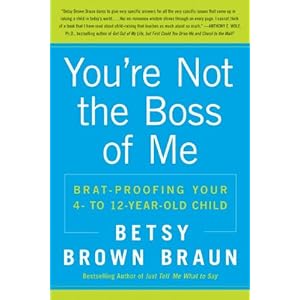
Book Review – You’re Not The Boss Of Me

April 11, 2010 by dadofdivas

About the Book

What parent hasn’t thought her child was a brat at one point or another?  Whether your child really is a brat, is at risk of becoming one, or is simply trying to grow up in a world filled with temptations and distractions, Betsy Brown Braun, bestselling author of Just Tell Me What To Say, has written the ultimate hands-on guide to cultivating, character traits that are tried and tested brat busters including gratitude, respect, honesty, independence and self reliance, among others.

Betsy’s down-to-earth advice and no-nonsense practical “tips and scripts” are derived from her expertise working with thousands of children (from toddlers to teens) and parents for over three decades. With Braun’s humorous, supportive and authoritative voice as a guide, parents can navigate some of the more difficult aspects of these formative years and lay the groundwork for their child’s future with confidence.

About the Author
Betsy Brown Braun, best selling author of the award winning book Just Tell Me What to Say: Sensible Tips and Scripts for Perplexed Parents (HarperCollins, 2008), is a child development and behavior specialist, parent educator, multiple birth parenting consultant and founder of Parenting Pathways, Inc.

Betsy leads parenting groups, seminars, and offers private parent consultations throughout the nation. With over 35 years of experience in public and private early childhood and elementary education, Betsy has directed and founded school programs, taught in both public and private schools, has been a school director, and was the founding director of Wilshire Boulevard Temple’s Early Childhood Center. She holds an MA in Human Development and teaching credentials from Pacific Oaks College.

In 2001 Betsy founded, Parenting Pathways, Inc. to provide guidance  to parents seeking the skills and confidence needed to negotiate the often-challenging parenting pathway. Her bestseller now in its 4th printing, Just Tell Me What To Say, presents the tried and true tools her clients use daily to handle situations that inevitably accompany raising children ages 2-6 and beyond. Just Tell Me What To Say has been translated into Greek, Korean, Portuguese, and Russian. Her second book, You’re Not
The Boss Of Me: Brat Proofing Your Kids will be released in April 2010.

Betsy’s parenting expertise has been featured in USA Today, The Wall Street Journal, The New York Times, U.S. News & World Report, Cookie, Family Circle, Nick Jr., Parents, Parenting, Pregnancy and Newborn, Toddler, Twins, and Woman’s Day, among other publications. She has shared her expertise on the Today Show multiple times. Other television appearances have included The Early Show, Entertainment Tonight, Good Morning America, KNBC, and Fox News LA. She contributes to KNX news radio on child development, and has been a guest on countless radio programs nationwide, including NPR. Betsy is a frequent speaker at educational conferences, schools, and businesses.

Betsy and her husband Ray Braun are parents of adult triplets.

My Take on the Book
As a and parent I am always looking for advice on how to do better and be a better parent for my girls. As any parent knows, there are definitely no true guidebooks to being a parent, and much of what we learn is hands on, which means that at times we make mistakes (but isn’t that how we learn?).

This book is a treasure trove of resources that were very down to earth. I enjoyed how easy this book was to read and how user friendly the advice was. I found myself taking bits and pieces of each chapter and trying to implement them within my own family with positive results.

What I loved most about the book was that in every section of the book there were numerous examples of how a parent could implement the strategies, this alone was worth the read!

I completely recommend this book to any parent trying to get a bit more help with their child, you will not be disappointed, I know I wasn’t!

If you you would like to have this book as a part of your own collection, you can find it on Amazon!

——————————————————————————————-
New to the Divadom?
Please Subscribe to my RSS Feed! Subscribe in a reader
Questions?Drop me a line at dadofdivas@gmail.com

Filed Under: book review, parenting Tagged With: books, discipline, parenthood

Priceless Parenting – A Great Training Instrument For Parents

September 9, 2009 by dadofdivas

I was pleased to be offered the opportunity to review a great parenting resource over the past few months called Priceless Parenting.

I had the opportunity to interview Kathy prior to accessing the content of her site and I can tell you that she truly is a down to earth individual who is all about helping parents become better parents while at the same time working to let parents lower their stress levels while increasing the responsibility of children.

Not only does Kathy maintain her company’s website and the free and paid resources that are included, she also maintains the priceless parenting blog that provides parents with wonderful tidbits and helpful hints about being a better parent.

The Priceless Parenting Course

The Priceless Parenting course is a must have for parents no matter how veteran. The topics that she covers impacts all ages from infant to adult children.

The program is very user friendly. It is a web based training that is broken down into 7 Lessons with topics including:

  • Parenting basics
  • Sharing control
  • Problem ownership
  • Letting your kids think
  • Consequences
  • Chores
  • Bringing it all together

The program is very accessible with a secure login for people taking the course. Each lesson is supposed to take about an hour. I was able to get through some of them a bit quicker, but if you were going to take this with your spouse/partner (I would highly recommend it), it may take longer as you discuss issues and topics as they are presented.

The lessons are narrated by Kathy and uses down to earth, real life examples which truly makes the training that much more pertinent. Each lesson even has a homework section that you and your partner can work on together.

Unlike many parenting programs out there, this program is completely self paced. The program allows you to move as quickly or slowly as you would like. The online format/video based format of the program allows you to use forward and back arrows as much or as little as you like to move seamlessly between the topical areas that you know and the areas you may need to hear again. This toolbar also allows you to pause the program as needed, so if you have a parental disturbance (as many of us do) you can deal with it and then go back to the class, starting up where you left off.

The program is somewhat similar to the ideals brought up in some of the other parenting books I have read in the past. Kathy commented that she had tried to use the best of the resources that she was aware of to develop this program adopting the best of the best and taking out the parts that just did not work. She also put in personal and other examples to make the training even more meaningful.

I truly appreciated all of the material that was covered within the training. I have never gone through a formal training like this before and I found myself always looking forward to the next lesson and the learning that it would impart. I already find myself using the knowledge from this course with my eldest (Diva-J). One of the biggest things that I have been trying lately from the training is the idea of choices and providing choices for Diva-J to allow her the freedom to make mistakes and offer learning moments.

I also have to put in a plug for the cartoons that she uses in parts of the lessons. As a fan of the Baby Blues cartoons, she uses these cartoons well to emphasize her points.

This training is inexpensive in terms of what you get and in terms of what else is out there on the market for parenting courses. For 3 months access to the site you pay only $65, and Kathy will even let you register on her site for access to the first lesson to try things out.

Recently the Huffington post just ran an article on the importance of parent education: http://tinyurl.com/ljkxvc in which Kathy was interviewed.


For those of you who do not know Kathy, let me shed some light on who she is… from her website itself, Kathy Slattengren is:

a noted parenting educator and presenter who created Priceless Parenting in 2007. She has a deep commitment to teaching parents the critical skills needed for effectively responding to misbehavior while guiding children to becoming responsible and respectful.

While raising her own two children, she learned many wonderful
parenting techniques from classes, seminars and books. Through studying research, she discovered a universal body of knowledge about how effective parents do their job. Her Masters of Education degree from the University of Washington combined with her Bachelor’s degree in Psychology and Computer Science from the University of Minnesota has enabled her to pull together
parenting research into a course that is easy to understand and apply. After
teaching numerous parenting classes, she knew that parents really benefited when
they learned more effective parenting techniques.

Parents reported how much happier and calmer their homes were after using
the new techniques. Wanting to share this valuable information with parents
everywhere, she created an online course so parents could learn these valuable
skills at their own pace and from the comfort of their own home.

I whole-heartily encourage all of you to check out Priceless Parenting to become an even better parent!

————————————————————————————————
New to the Divadom?
Please Subscribe to my RSS Feed! Subscribe in a reader
Questions?Drop me a line at dadofdivas@gmail.com

I look forward to seeing you back here again!

Filed Under: parenting Tagged With: choices, discipline, parenthood, priceless parenting, training

Find Me

Archives

Copyright © 2026